Home
News & Shows
Pics n clips
Music
Bio
Live
Blue Oyster Cult
Production
2 Part Invention
Fun
Links
Buy CDs
forum
myspace
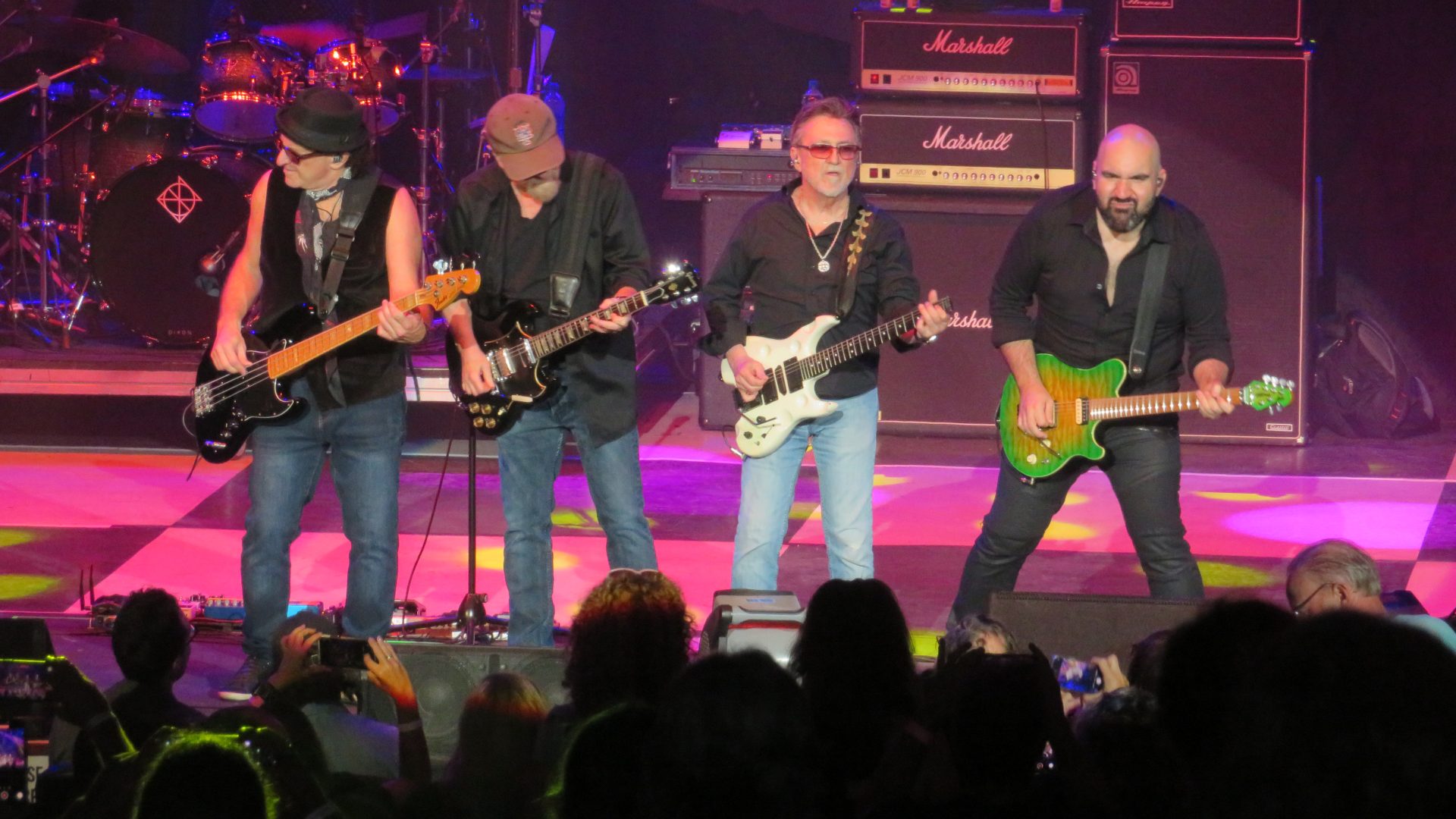
(l to r) Me, Buck Dharma, Jules Radino, Allen Lanier, Eric Bloom

I've been involved with Blue Öyster Cult since 2000. I started out as a substitute front of house sound engineer. Then, in 2004, I was asked to join as a member of the band. Here is a lineup timeline since I joined the band:

2004:
Buck Dharma - Voc/Gtr
Eric Bloom - Voc/Gtr/Keys
Allen Lanier - Gtr/Keys
Bobby Rondinelli - Drums
Me - Bass/Voc
2004 - 2006
Buck Dharma - Voc/Gtr
Eric Bloom - Voc/Gtr/Keys
Allen Lanier - Guitar/Keys
Me - Bass/Voc
Jules Radino - Drums
2006 - 2007:
Buck Dharma - Voc/Gtr
Eric Bloom - Voc/Gtr/Keys
Me - Gtr/Keys/Voc
Jules Radino - Drums
Danny Miranda - Bass/Voc
(on occasion Jon Rogers played bass as well)
2007:
Buck Dharma - Voc/Gtr
Eric Bloom - Voc/Gtr/Keys
Me - Gtr/Keys/Voc
Jules Radino - Drums
Rudy Sarzo - Bass/Voc

Here are a few images from the road...
(click to see them larger)

BÖC - 2007
Me, Rudy Sarzo, Eric Bloom - 2007 (photo by Rev. Che'San)
Me - 2007 (photo by J. Rabkin)
BÖC - 2007 (w/ Danny Miranda on bass)
Buck Dharma (yes, the Buck Dharma) and Me - 2007
BÖC - 2005
Jules Radino and Me - 2006 (photo by J. Galarneau)
Me - 2004 (photo by K. Dwyer)

GEAR

I PROUDLY endorse Ernie Ball Music Man guitars, VHT Amplifiers, and DiMarzio pickups. You just can't go wrong with that combination.
I am also a big fan of Audio Techinica. My wireless rules.

My current live BÖC rig is...

+

That's the gist of it. If you want more details, read on...


GUITAR

Ernie Ball - Music Man

Silhouette Special

Color - Blue Pearl (black pickguard)

Body Wood - Alder

Neck Wood - Maple w/oil finish

Tuners - Schaller Locking

Bridge - Music Man Tremelo

Pickups:

  • DiMarzio Cruiser Humbucker Neck (not shown)
  • DiMarzio Custom Single Coil
  • DiMarzio Custom Humbucker

Frets - 22 high profile

Special - This guitar was modified by LeRoy Aiello. The battery was removed and the pickup selections were changed slightly. On my guitar, the middle position on the pickup selector is actually the neck and bridge pickup together. I did this because I rarely used the middle pickup alone, and on my music man EVH guitar I frequently use the sound of the neck and bridge pickup together.


OTHER GEAR

Keyboard Rig

  • Korg O1/W
  • Hammond XK-2
  • Roland A-80 Controller
  • Alesis NanoPlane Piano (not shown)

not shown:

  • Behringer FCB-1010 MIDI Footswitch
  • Boss TU-12H Tuner
  • Shure E-3 in ear monitors
  • Sensaphonics molded ear sleeves
  • Dunlop picks


Rack Gear (in signal flow order)

2 Furman Merit Power Conditioners

Audio Technica AEW-4110 wireless

VHT Valvulator GP3 Preamp
-3 channels
-All Tube
-graphic EQ
-MIDI controllable
-Dynamics Control

BOSS AC-2 Acoustic Simulator Pedal
(in Preamp FX Loop)

Digitech IPS-33B Super Harmony Machine
-Intelligent Pitch Shifting
-Basic Effects Processing
-MIDI controllable

TC Electronic G-Force
-Advanced Effects Processing
-8 Effect Blocks per Preset
-MIDI Controllable
-Intelligent Pitch Shifting

Shure PSM-4 personal monitor system

Crate Vintage 30 4x12 Cabinet

Special Notes:

Equpiment varies, depending on availability of certain gear, our travel siutation, or how I feel that day.

The in-ear monitor system is 4 channels only. I can only hear my vocals, guitar, and keyboards. Everything else comes from floor wedges or ambience bleeding into my vocal mike. It's low-tech, but it gets the job done.

Woody is also responsible for how the rig sounds through the house, so he's definitely a big part of my tone.


CREW

BÖC's crew is amazing, they make it possible to keep up our crazy touring schedule

Steve "Woody" LaCerra - Tour Manager/FOH
Eric "G-Man" Gormley - Stage Tech
Aaron "Snow Plow" Melling - Stage Tech
Tony "Jack Secret" Geranious - Stage Tech
Reverend Che'San - Production Assistant
Andrew "No Nickname" Gearhart - Stage Tech

BASS GEAR

OK gear heads, I'm going to open this page up with a detailed description of my bass rig.

THE FOOF

This bass is called "The Foof." I named it after my Uncle Phil who pretty much made "The Foof" the ass kicking machine that it is. "The Foof" is actually an Ibanez SR-505, which is a stock 5 string bass with a very nice feel. Uncle Phil painted it canary yellow (my favortie color) and changed the electronics to meet the requests of BOC's live sound engineer.

To check out THE FOOF on the ibanez website click here

For a step by step description of how "the foof" was modified click here

Here are the specs....

Neck: 5 piece Wenge/Bubinga Bolt On

Neck Size: 45mm to 67 mm (34 inch Scale)

Frets: 24 medium frets

Fretboard: Rosewood

Neck Finish: Oil

Headstock: Ibanez SR 5-string style w/ Custom Kronos Logo

Bridge: Accu-Cast B25

Body: Mahogany

Color: Canary Yellow

Neck Pickup: Bartolini P2(B) dual coil. Bright sound.

Bridge Pickup: Bartolini P2(T) dual coil. Bright sound.

Electronics: Bartolini HR-5.4 Wiring Harness. Click image below for details.


THE FOOF in Action

(Photo by Kira Dwyer)

A lot of people ask my why I decided to play a 5 String bass in BÖC. That question has a few answers. The bass player before me was my friend Danny Miranda. Danny is an amazing bass player. Although he was playing a 4 string bass, he frequently played notes below the low E on the bass. He achieved this by using a hipshot drop-D tuning machine on his E string. He would constantly drop his low E string to grab the low D's whenever he needed to. He would also use an octave pedal to play even lower than the D note. When I was learning the BÖC songs I frequently heard super low notes on the live recordings with Danny playing. Instead of relying on the hipshot and the octave pedal for those notes, I figured that playing a 5-string was the simplest solution for me personally.

My other reason for playing a 5 string is that it allows me to focus on other things. At this point I could probably play a 4 string bass with BÖC. Now that the band has a completely new rhythm section, I find myself relying more on the original recordings of Joe Bouchard's bass lines for reference. All of those parts were recorded with a 4 string. In fact, I used my 4 string Rickenbacker 4001 on a few shows in the winter. The reason I find myself going back to the 5 string is that I find I don't have to concentrate on fingerings and positions as much. With the 5th string I can stay in certain positions for longer amounts of time without running out of neck. That gives me the opportunity to focus on singing and performing.

Amplification

I really lucked out in this department. It just so happens that BÖC is endorsed by the greatest bass amp company in the world. AMPEG!!! My favorite bass sound ever is definitely the Chris Squire sound. I was so excited to find out that I was going to get to use the same amp/cabinet combination that Chris Squire uses.

Amplifier: Ampeg SVT-2 Pro

  • 4 x 12AX7, 1 x 12AU7 preamp tubes
  • 1 x 12AX7, 2 x 12AU7 driver tubes
  • 6 x 6550 power amp tubes
  • 300 Watt RMS power output
  • 3 band tone controls
  • 5 position mid control
  • 9 band Graphic EQ
  • Ultra low and high boosts
  • Tube Drive control

Cabinet: SVT-810E Classic

  • 8 x 10" speakers
  • 58 Hz to 5 kHz Frequency Response
  • 4 Ohms nominal impedance
  • Custom Red Tolex

Toys

My setup has grown quite a bit in the last few months. After my bass, the first step in the chain is an Audio Technica AEW-4110D wireless. The output from the wireless goes into a boss pedal board with a tuner, noise gate, and various effects. The output of the pedal board goes into a Direct Box which splits the signal to the amp and to the PA. I'm going to be adding a DBX 163x compressor into the chain before the direct box in the near future.

I've also begun to use in-ear monitors with the band. These are a great help when you have to sing really soft parts in a very loud environment. They also help preserve your hearing. I wanted to make the monitoring system safe and simple. Most of the time we don't have the same monitor engineer, so rather than let someone I don't know destroy my hearing, I do my own monitor mix from the stage. Here's how this works...

I use a Shure P4M 4 channel mixer, that has a split out on each channel. My vocal microphone goes into channel 1, then splits out to the PA without being affected. The microphone on the bass cabinet goes into channel 2 and also gets split out to the PA. In Channel 3 is an Audio Technica 4033 condenser microphone. This microphone is very carefully and strategically placed because it's the only way I will hear what's happening on stage. I usually put this mike next to my floor monitor pointing toward the area in between Buck's amp and the drums. This way I can hear my on-stage monitor mix and the band. The output of the P4M mixer goes into a P4T wireless transmitter and that transmits to a P4R body pack receiver. I'm using the Shure E3c earphones with the foam buds.

This is Buck's Rack, but I keep my Audio Technica AEW-4110D Wireless in here. It's the second unit from the top.

This is my Boss BCB-60 pedal board.

  • NS-2 Noise Suppresser
  • LM-1 Limiter (which I will be removing soon)
  • BF-2 Flanger
  • AW-3 Dynamic Wah
  • ODB-3 Bass Overdrive
  • OC-3 Super Octave
  • TU-8 Tuner
On top of the SVT-2 Pro bass amp, you can see my Shure in-ear monitor system. It's pretty new so we haven't had the chance to rackmount it yet.